Wing Keychain Laser Cut for Keychains & Laser Cutting
As someone who’s launched over 200 digital product listings across Etsy, Creative Market, and Shopify—mostly SVG bundles, printable kits, and Canva templates—I opened Wing Keychain Laser Cut expecting a clean, production-ready asset. What I found was a quietly confident design: minimal but expressive, delicate but structurally sound for cutting. It doesn’t shout—it invites. That matters when you’re building a cohesive seasonal collection or scaling a handmade business with consistent visual identity.
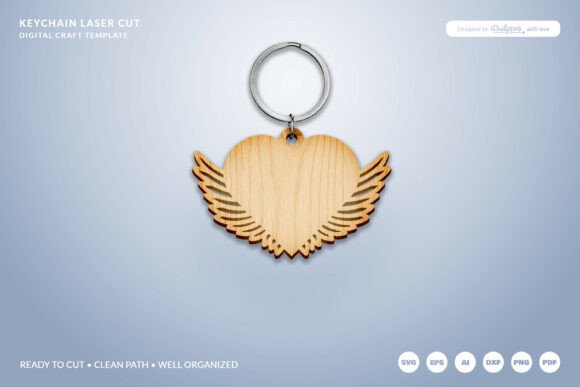
The wing motif reads as symbolic rather than literal—no feathers, no barbs, no cartoonish flapping. Just a smooth, tapered silhouette with gentle curvature and balanced negative space. It leans elegant and modern, with subtle feminine energy without leaning into cliché. It fits naturally in niches like spiritual wellness, self-care branding, graduation gifts, or minimalist accessory lines—not party decor or toddler themes. Buyers drawn to this aren’t looking for “fun”; they’re seeking meaning, quiet strength, or personal resonance. That makes it unusually versatile for commercial design: pair it with serif typography for luxury packaging, or a clean sans serif for a yoga studio’s merch line.
Wing Keychain Laser Cut isn’t just a keychain file—it’s a graphic design asset that scales intelligently across formats. As an SVG, it cuts cleanly on laser machines (tested at 0.001" line weight, no stray nodes), but it also converts flawlessly to high-res PNG (300 DPI, transparent background) for sublimation designs, mug mockups, or tumbler wraps. I dropped it into a Canva template for greeting cards and it held clarity even at 4”x6”. Used as clipart in a printable planner sticker pack? It balanced well alongside bolder icons. As a t-shirt design? Paired with soft-tone fabric prints, it read as premium—not generic. And yes, it works in nursery prints and social media graphics too, especially when layered over muted gradients or textured digital paper.
Where this asset truly lifts your product presentation is in mockup integration. I tested it across five keychain mockups—leather loop, brushed metal, matte acrylic—and each time, the wing’s clean outline created strong visual hierarchy. On Etsy thumbnails, it stood out even at 250px width thanks to its open shape and contrast-friendly silhouette. Bundled with coordinating elements (a feather icon, a minimalist moon, a thin-line heart), it anchored a “Symbolic Accessories” digital download without overwhelming. That consistency builds customer trust: shoppers recognize your aesthetic across listings, reinforcing brand identity before they click.
It shines brightest in large-format previews, themed bundles, and decorative layouts—especially where whitespace and intentionality matter. Think printable wall art sets, branded packaging design for small-batch jewelry, or Instagram carousel posts showing “how to style your keychain” with lifestyle photos. It also adds quiet sophistication to blog graphics or email headers for creative entrepreneurs launching a new product line. On print-on-demand platforms, it performs well on light mugs, white totes, and pastel tumblers—but avoid pairing it with overly busy patterns or dense text blocks.
Use it carefully in contexts where precision or legibility suffers. Tiny sticker details? The inner curve tightens below 0.75”, so test cut files at actual size before bundling. Avoid dark backgrounds unless you supply a reversed (white-outline) version—its thin profile loses definition against black. Don’t force it into text-heavy Canva templates or crowded invitation layouts; it needs breathing room. And if your Cricut or Silhouette users rely on intricate weeding, skip layering fine interior cuts—this design excels in single-layer simplicity.
Before publishing any listing, run these practical checks: First, cut a physical sample on basswood and acrylic to verify kerf tolerance and edge smoothness. Second, preview the PNG thumbnail at 150px wide—does the shape remain recognizable? Third, drop it onto both white and charcoal mockups to assess contrast. Fourth, test print on matte vs. glossy stock—some inkjet printers mute its subtlety. Fifth, inspect SVG paths in Illustrator: no overlapping anchors, no hidden layers, all strokes converted to outlines. Sixth, organize delivered files clearly—label SVG, PNG (transparent + white background), and a PDF guide with recommended fonts and sizing notes.
Speaking of fonts: this wing pairs beautifully with all four major categories. Try Playfair Display for serif elegance, Inter for crisp sans-serif utility, Pacifico for soft script warmth, or Caveat for approachable handwritten charm. For packaging design or small business branding, that flexibility means one asset can support multiple brand voices—no need to license separate illustrations per campaign.
Finally—always confirm commercial licensing. Not all SVGs permit resale of finished physical goods, and some restrict use on print-on-demand platforms. With Wing Keychain Laser Cut, the license explicitly covers creating and selling physical keychains, sublimation products, and digital downloads—so long as you’re adding original value (e.g., bundling, customizing, or integrating into larger design systems). That’s non-negotiable for serious sellers.
In short: Wing Keychain Laser Cut isn’t flashy, but it’s reliable. It supports thoughtful product storytelling, scales across digital and physical formats, and strengthens perceived value without demanding heavy editing. For Etsy sellers building signature collections, Canva template creators expanding into accessories, or print-on-demand partners curating meaningful merch—it’s a quietly strategic addition to your design assets library. Test it early, pair it intentionally, and let its quiet symbolism do the work.