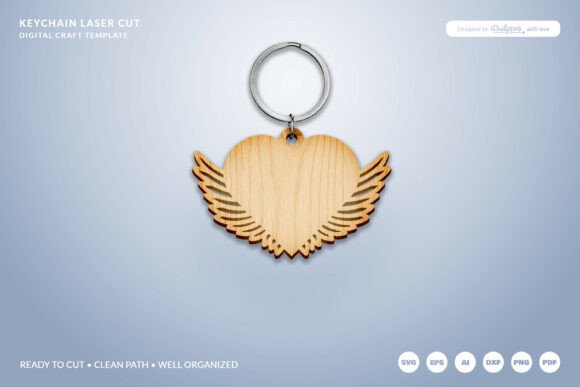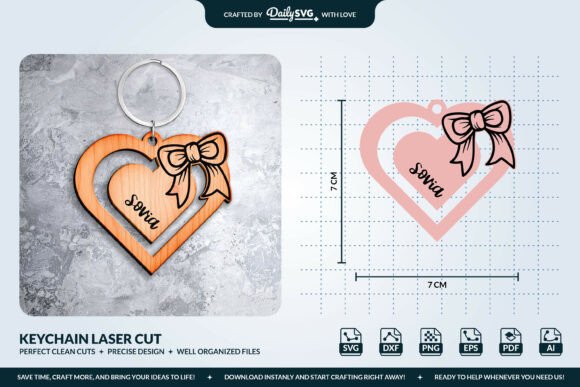
Butterfly Keychain Laser Cut Template
A Designer’s First Glance: Graceful, Not Fussy
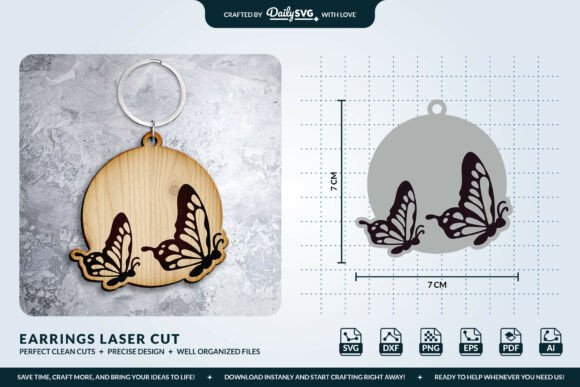
When I opened the Butterfly Keychain Laser Cut Template, what struck me wasn’t just the shape—it was the breathing room. This isn’t a butterfly crammed into a tight square or stretched to fill every pixel. It’s poised, with gentle wing curves and subtle asymmetry that feels hand-drawn, not algorithmically generated. The lines are clean but not sterile—there’s softness in the outer edge, just enough to suggest organic movement. As an embroidery designer who regularly adapts laser-cut templates for stitch work, I immediately saw how this would translate: minimal internal detail means fewer tiny satin-stitch traps, no fragile antennae that vanish under dense fill, and wings that read clearly even at 1.5 inches tall on a tote bag strap or baby onesie.
Real Project Test: Stitching It Into a Nursery Gift Set
Last week, I used the Butterfly Keychain Laser Cut Template as the anchor motif for a custom nursery gift set—three embroidered items: a muslin swaddle, a linen tea towel, and a leather keychain (yes, the actual laser-cut version). For the swaddle, I digitized the outline as a delicate running stitch border around a monogram; for the towel, I stitched it full-size as a standalone design using soft pastel threads. Customers responded most warmly to the towel—not because it was flashiest, but because the butterfly felt *intentional*. Its scale left space for the fabric’s texture to show through, and its quiet elegance matched the handmade aesthetic parents seek for baby gifts. That’s the real strength of this template: it doesn’t shout. It belongs.
Where It Shines—and Where to Pause
The Butterfly Keychain Laser Cut Template works beautifully on stable, medium-weight fabrics like cotton twill, linen, and midweight denim. On a sweatshirt cuff? Clean and confident. On an apron pocket? Timeless. As an embroidered patch? Holds up well after washing—no fraying corners or collapsed wingtips, thanks to its open silhouette and lack of micro-details.
But here’s where judgment matters: avoid using it directly on highly textured fabrics like bouclé or thick terry cloth without testing stabilizer layers first. On stretchy knits (think baby bodysuits), reduce stitch density slightly and add cutaway backing—those smooth wing edges can blur if the fabric shifts mid-stitch. And on dark fabric? Don’t assume black thread will read. Try a heather gray or deep navy satin stitch instead—it preserves delicacy without disappearing.
Commercial Realities: What Your Customers Actually See
If you’re an Etsy seller or small shop owner, remember: buyers don’t buy “a butterfly.” They buy *meaning*—gentleness, transformation, lightness. The Butterfly Keychain Laser Cut Template supports that narrative because it doesn’t compete with the product it’s on. A keychain made from it feels special without being fussy; a tote bag featuring it reads as thoughtful, not trendy. That builds trust. When your embroidered patch or holiday gift feels cohesive—not like a stock design slapped on—it tells customers you curated, not copied.
I’ve seen too many craft businesses undermine their brand by overloading designs: tiny flowers inside wings, excessive inner lines, or forced symmetry that reads robotic. This template avoids all that. Its simplicity is strategic. It leaves room for your thread palette, your fabric choice, your voice as a maker.
Practical Notes Every Embroidery Designer Should Check
- Test first on scrap fabric—especially if stitching on curved surfaces like caps or layered garments (e.g., a quilted pillow cover).
- Review stitch density before scaling. At under 2 inches wide, dense fill stitches can overwhelm; lean into satin or running stitch outlines instead.
- Confirm hoop size compatibility. This design fits comfortably in a 4x4 hoop—but verify your digitized version respects that boundary, especially if adding text or borders.
- Inspect small details in your embroidery software: antenna tips, wing veins, and outer curves should be at least 0.8mm thick to prevent breakage or skipped stitches.
- Mock it up in black and white before finalizing thread colors—contrast matters more than hue for clarity.
- Use appropriate stabilizer: tear-away for stable wovens, cutaway for knits or lightweight fabrics.
- Check licensing before selling finished items or digital embroidery files derived from this template. If commercial use isn’t explicitly permitted, contact the creator.
Beyond the Keychain: Why This Design Earns Repeat Use
Yes, it’s labeled a keychain template—but its value stretches far beyond metal rings and split rings. I’ve adapted it for embroidered appliqué on denim jackets, simplified it into a minimalist iron-on patch for kids’ backpacks, and even used its wing contour as a guide for hand-embroidered French knots on a kitchen towel. Its versatility lies in its restraint. There’s no clutter to edit out, no unnecessary elements to disable. It’s a solid, quiet foundation—not a finished product shouting for attention.
For apparel decorators and boutique owners, that means faster turnaround and fewer client revisions. For hobbyists and makers, it means less frustration when a tiny wing tip vanishes under stitching or a dense fill puckers thin fabric. And for anyone building a recognizable craft business? Consistency starts here: one elegant, adaptable motif that feels like *yours*, not just another download.
The Butterfly Keychain Laser Cut Template won’t wow with complexity—but it delivers something rarer in embroidery design: quiet confidence. It knows its role. And when you’re choosing design assets for real projects—custom apparel, personalized gifts, holiday merchandise, or daily shop inventory—that kind of clarity is worth more than any extra flourish.