Did Someone Say Tequila
A Designer’s First Look: Playful, Not Precious
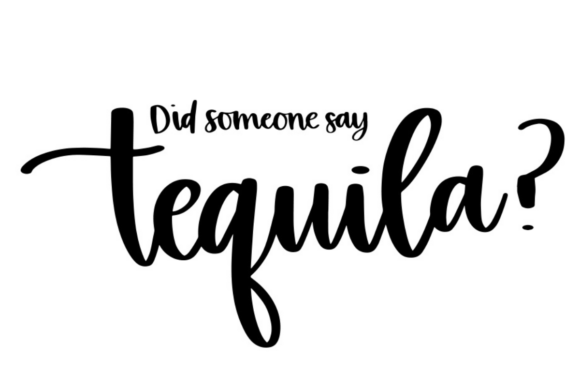
When Did Someone Say Tequila landed in my inbox, I paused—not because it startled me, but because it *landed* so cleanly. No overwrought graphics, no cluttered borders, no forced “fun.” Just confident contrast between a relaxed hand-lettered script (“Did Someone Say”) and a bold, upright “TEQUILA” that feels like a wink you can’t help returning. As an embroidery designer who’s stitched everything from nursery monograms to boutique apron collections, I immediately saw its home: on a linen tea towel for a friend’s taco night, front-and-center on a heavyweight cotton tote for a local distillery pop-up, or even as a small chest embroidery on a baby onesie (yes—irony fully intended, and fully charming).
Where It Shines—and Where It Needs Thought
Did Someone Say Tequila thrives where personality meets practicality. On a medium-weight sweatshirt? Excellent. The script flows with the drape, and the uppercase “TEQUILA” holds crispness without needing excessive stitch density. On a custom embroidered patch? Strong candidate—its clean silhouette reads well at 3–4 inches wide, and the balance between thin entry strokes and sturdy letterforms means satin stitch edges stay sharp, not fuzzy.
But let’s be real: this isn’t a design that forgives shortcuts. On stretchy fabric like lightweight knits or curved surfaces like baseball caps, the script’s delicate connectors—especially the tail of the “y” and the crossbar of the “A”—need careful digitizing attention. If your version lacks proper underlay or reduced pull compensation, those fine transitions may pucker or distort. Likewise, on dark fabric, avoid light thread unless you’re using high-contrast stabilizer underneath; the script’s open spacing means thread lift or shadowing becomes visible faster than with denser fill-stitch designs.
Real Project Test: A Linen Kitchen Towel Series
Last month, I used Did Someone Say Tequila in a small-batch kitchen towel line for a local maker’s market stall. We chose natural linen—textured, breathable, and unforgiving of sloppy stitching. I ran three test runs: one on standard tear-away stabilizer, one with cut-away + topping, and one with light iron-on topping only. Result? The topping combo gave the cleanest script definition, especially in the lowercase “d” and “l,” where thread nesting was minimal and the hand-drawn rhythm stayed legible. Without topping, the linen’s slubs interrupted the flow just enough to soften the charm. Customers responded instantly—not just to the humor, but to how *intentional* it looked. That matters. A playful phrase loses trust if it looks accidental.
What It Adds to Your Finished Product
- Visual appeal: It elevates casual items without feeling pretentious—ideal for craft business branding that balances wit and warmth.
- Stitching clarity: When digitized well, the contrast between script and block type creates natural visual hierarchy—no extra embellishment needed.
- Product value: Buyers recognize effort. This isn’t clipart—it reads as considered design, which supports higher price points for personalized gifts or boutique merchandise.
- Giftability: It lands perfectly for holiday embroidery (think hostess gifts), wedding weekend swag, or birthday surprises—humor that’s inclusive, not edgy.
Where to Proceed With Care
Don’t reach for Did Someone Say Tequila when your hoop size is under 4×4 inches *and* you need full fidelity—those subtle script lifts and tapered ends shrink fast. Avoid ultra-thin fabrics like voile or silk charmeuse unless you’ve tested stabilizer pairing thoroughly; the design’s openness doesn’t mask shifting. And skip dense decorative accents (like heavy beadwork or layered appliqué) near the text—it competes rather than complements.
For baby embroidery? Yes—but place it thoughtfully. Centered on a bib? Risky—the script’s energy reads better on larger, flatter surfaces like a blanket corner or a pillow cover. On a onesie? Best as a single-line running stitch version, simplified for scale and safety.
Practical Notes Every Embroidery Designer Should Run Through
- Test the Did Someone Say Tequila embroidery file on scrap fabric matching your final product’s weight and texture.
- Check thread color contrast on both light and dark mockups—especially for Etsy listings where buyers rely on digital previews.
- Review stitch density: too sparse, and the script fades on textured fabric; too dense, and “TEQUILA” loses its elegant weight.
- Confirm hoop size compatibility—some versions may require 5×7 or larger for optimal spacing.
- Inspect small details at actual stitch-out size: does the “q” loop hold shape? Does the “a” counter stay open?
- Try black-and-white printable mockups—this design’s strength is in its tonal contrast, not color.
- Use appropriate stabilizer: cut-away for knits, tear-away + topping for linens or towels, and always test wash one sample before production.
- Verify licensing terms—especially if you plan to sell finished products or include it in digital embroidery bundles for other crafters.
Final Thought: Charm With Craftsmanship
Did Someone Say Tequila works because it respects the craft behind it. It doesn’t shout. It leans in. It invites a smile, then earns it with thoughtful structure. For Etsy sellers building cohesive collections, small shop owners curating handmade product lines, or designers stitching custom apparel for local brands—it’s not just a graphic. It’s a quiet signal: *we pay attention to detail, even when we’re having fun.* That’s the kind of design that turns a simple tote bag into a conversation starter, and a holiday gift into a keepsake. Just remember: its spirit is genuine, so your execution should be too.