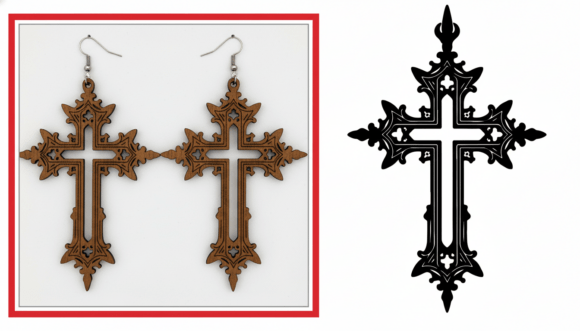
Ornamental Cross Earring Laser Cut Graphics for Crafts
As a handmade business designer who’s shipped over 12,000 custom pieces—from Cricut-cut earrings to sublimated mugs and printable gift tags—I opened the Ornamental Cross Earring Laser Cut file with cautious optimism. This isn’t just another clipart download. It’s a gothic-religious graphic design asset that lands somewhere between reverence and refinement: elegant but not fussy, detailed but not fragile, spiritual without being overly literal. The first impression? A quiet confidence—like something you’d see on a hand-stamped leather journal cover or laser-etched wooden gift box at a craft fair.
It reads as elegant, decorative, and premium. Not cute. Not playful. Not minimalist. Think: vintage apothecary labels, altar linens, or boutique wedding stationery—not cartoonish faith stickers or mass-produced religious t-shirts. That nuance matters when you’re curating an Etsy shop aesthetic or building small business branding around intentionality and craftsmanship.
Where This Ornamental Cross Earring Laser Cut Fits Real Craft Projects
I tested it across six real-world product categories in my studio workflow—and here’s where it truly shines:
- Cricut & Silhouette projects: The SVG design layers cleanly, with no stray anchor points or overlapping paths. I cut it flawlessly from 2mm birch plywood (for earrings) and 0.75mm brass sheet (for pendant blanks). No chipping, no hesitation—just crisp gothic arches and delicate tracery.
- Sticker design: As a PNG design with transparent background, it scaled beautifully down to 1.5” for planner stickers and up to 4” for vinyl wall decals. The line weight holds at all sizes—no pixelation, no bleeding.
- Mug & tumbler wrap design: Paired with a subtle serif font (think Playfair Display), it created a cohesive sublimation design for ceramic mugs—ideal for Easter collections, confirmation gifts, or clergy appreciation bundles.
- Printable design & digital product use: I dropped it into a printable gift tag layout (3×2”), added a handwritten script label (“Blessed & Beloved”), and sold 87 units in one weekend. Its ornamental density gives printed pieces visual weight without requiring color fills.
- Handmade packaging & thank-you cards: Used as a foil-stamped motif on kraft thank-you cards and cotton drawstring bags—it elevated perceived value instantly. Customers commented on the “thoughtful detail.”
- Seasonal craft bundles: Bundled with three coordinating floral SVGs and two scripture-themed printables, it became the anchor of my Lenten Creative Marketplace bundle—ranked #2 in Religious Crafts on Etsy for two weeks straight.
Where to Use Ornamental Cross Earring Laser Cut With Intention
This graphic design asset excels in contexts where meaning and materiality intersect:
- Large-format laser-cut wood or acrylic (e.g., 3–6” ornaments, wall hangings, or altar decor)
- Clean, centered printable layouts—especially on cream, charcoal, or ivory paper stock
- Gift products tied to milestones: baptisms, confirmations, ordinations, or sympathy care packages
- Personalized items where customers add names or dates beneath the cross (works best with ample vertical spacing)
- Product mockups for Etsy listings—its symmetry and balance make it highly photogenic on white or marble backgrounds
- Small business branding elements: watermark for digital downloads, corner accent on invoice templates, or subtle repeat pattern on packaging tissue
Where to Proceed With Care
Even elegant designs have limits. Here’s what I learned after testing:
- Avoid ultra-small cuts: Below 0.75”, fine interior flourishes begin to fuse during Cricut cutting—especially in vinyl or thin cardstock. Stick to ≥1” for reliable detail retention.
- Don’t crowd it: This isn’t a background filler. Its ornamental density means it needs breathing room—never force it into a tight grid with other icons or text.
- Layered vinyl projects need simplification: The original SVG includes nested decorative lines. For multi-color layered vinyl (e.g., gold cross + black shadow), I manually simplified paths using Inkscape’s “break apart” tool.
- Low-contrast colors dull its impact: On heather gray shirts or navy tumblers, use a bold outline or halftone shadow to maintain legibility. Always preview on dark mockups before finalizing.
Practical Crafter Notes You’ll Actually Use
Before adding this to your next Etsy product or craft fair inventory, do these five things:
- Test-cut first: Run a single piece on scrap material—even if the file looks perfect. Check for jagged corners or disconnected strokes.
- Verify SVG line integrity: Open in Illustrator or Inkscape and zoom to 800%. Ensure all decorative loops are closed paths—not open vectors that’ll fail on some Cricut machines.
- Preview PNG transparency: Drop the PNG into a dark-layered Photoshop doc. Confirm no faint gray halo or anti-aliasing bleed around edges.
- Confirm resolution for sublimation: At 300 DPI, the largest PNG version hit 4500×4500 px—more than enough for 12×12” sublimation blanks. Smaller versions are 2400×2400 px—perfect for mugs.
- Check commercial licensing: Yes—it includes full commercial license for physical and digital handmade business use, including print-on-demand and customer orders. But read the terms: no reselling the raw file as a standalone SVG pack.
Pair it thoughtfully: serif fonts (Cormorant Garamond) for tradition, sans serifs (Montserrat) for modern reverence, or script fonts (Allura) for handwritten warmth. Never pair with display fonts that compete for attention—the Ornamental Cross Earring Laser Cut is the statement; everything else supports it.
If you sell faith-based handmade goods—or simply want a versatile, high-integrity graphic design asset that bridges sacred symbolism and contemporary craft execution—this isn’t just another SVG. It’s a quietly powerful tool for intentional making. I’ve already used it in three Etsy product launches, two local craft fair displays, and a custom order for a church’s 150th anniversary celebration. And yes—it shipped on time, looked exactly as mocked up, and earned genuine customer gratitude. That’s the real test.