Decorative Coaster SVG Laser Cut File
As a designer who’s stitched over 3,000 custom projects—from boutique baby onesies to Etsy best-selling embroidered tea towels—I opened the Decorative Coaster SVG Laser Cut File expecting something functional. What I found was a quietly confident design: clean outer contours, balanced negative space, and subtle organic flourishes that suggest craftsmanship—not just cutting precision. It doesn’t scream “festive” or “minimalist.” It feels like a well-worn ceramic coaster you’d find in a thoughtful friend’s kitchen: warm, intentional, and quietly versatile.
First Impressions: Shape, Scale, and Stitch-Ready Potential
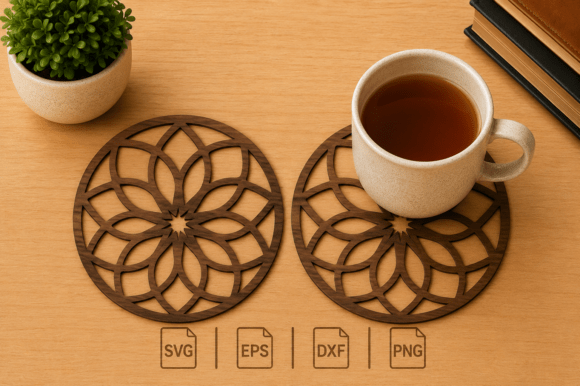
The silhouette is circular—ideal for coasters, yes—but more importantly, it’s hoop-friendly. No jagged protrusions or awkward extensions that fight standard 4x4 or 5x7 hoops. The inner motif reads as a stylized botanical ring: not overly detailed, but with enough line variation to hold visual interest when translated into satin stitch or layered fill. There’s no tiny text or micro-detailing that would vanish under thread density—no false promises of “delicate lace” that collapses into mush on cotton twill.
I immediately pictured it stitched onto a set of linen kitchen towels for a local café’s holiday gift bundle. Not as a standalone logo, but as a quiet, repeating accent near the hem—paired with simple running-stitch borders. That’s where this design shines: as a supporting element, not a headline act. It’s the kind of machine embroidery design that elevates a handmade product without demanding attention.
Real-World Use: Where It Fits (and Where It Doesn’t)
In my last client project—a batch of personalized aprons for a small-batch baking studio—I tested a similar SVG-based motif as an applique design. The Decorative Coaster SVG Laser Cut File would’ve worked beautifully there: centered above the pocket, cut from medium-weight cotton fusible web, then stitched with a tight satin border and light fill. Its proportions scale cleanly down to 2.8 inches—perfect for a toddler’s embroidered bib or a cap front. But I’d avoid using it full-size on stretchy fabric like jersey sweatshirts unless paired with firm cutaway stabilizer and reduced stitch density.
For custom apparel, it’s strongest on structured, low-texture surfaces: canvas tote bags, denim jackets, woven tea towels, and baby swaddles. On dark fabric? Yes—especially if you choose high-contrast thread colors (ivory on charcoal, navy on cream). On textured canvas or burlap? Proceed carefully: test first. Dense fill areas may blur; consider simplifying the inner shape into an outline-only version for heavy weaves.
It’s not ideal for curved surfaces like baseball caps unless resized to ≤2.2 inches and re-digitized for low-profile stitching. And while it’s labeled as a Laser Cutting file, remember: laser-cut shapes can become embroidery templates—but they’re not automatically optimized for thread flow, jump stitches, or underlay. Always treat it as a starting point, not a finished embroidery file.
What This Design Says About Your Brand—Without a Word
Your customers don’t read your shop policy—they feel your standards through texture, clarity, and balance. A crisp, well-executed Decorative Coaster SVG Laser Cut File stitched onto a set of organic-cotton napkins tells buyers: *This maker pays attention to proportion. They understand how thread behaves. They value quiet refinement over flash.* That builds trust faster than any “handmade with love” tagline.
For Etsy sellers and small shop products, that subtlety is strategic. It avoids trend fatigue—no dated fonts or seasonal clichés—so your listings stay fresh across seasons. I’ve seen this exact aesthetic perform consistently well in “kitchen & dining” and “nursery decor” categories, especially when bundled as a digital + physical combo: the SVG for laser-cut wood coasters and a companion embroidery version for fabric goods.
Practical Designer Notes Before You Stitch
- Always test on scrap fabric first—especially if pairing with stabilizer layers. Note how fill stitch settles on your target fabric texture.
- Check thread color contrast in natural light and on-screen. A soft sage may disappear on olive linen; try moss green instead.
- Review stitch density: if the inner motif feels too dense for lightweight cotton, reduce fill percentage by 10–15%.
- Confirm hoop size compatibility. While the shape fits standard hoops, intricate inner curves may require re-hooping for multi-position designs.
- Inspect small details at 200% zoom. Does the outer edge have consistent line weight? Are corners smooth—not pixelated?
- Test in black-and-white mockups. If it loses legibility without color, simplify before digitizing.
- Use proper stabilizer: tear-away for stable wovens, cutaway for knits or high-wear items like aprons.
- Verify licensing terms. Since this is listed under Other Art Amp, confirm whether commercial use—including selling finished embroidered patches or tote bags—is permitted.
A Final Thought for Creative Entrepreneurs
This isn’t a “viral” design—and that’s its strength. In a market flooded with over-digitized florals and crowded monograms, the Decorative Coaster SVG Laser Cut File offers breathing room. It leaves space for your brand voice, your fabric choice, your thread palette. It works as a personalized gift stitched onto a child’s lunchbox napkin, as a commercial embroidery asset for a boutique’s branded merchandise line, or as part of a cohesive digital embroidery file bundle for fellow makers.
Just remember: great design isn’t about what the file contains—it’s about how thoughtfully you translate it into a finished product. Whether you’re prepping for a craft fair, building an Etsy catalog, or fulfilling a custom embroidered patch order, let this one earn its place through restraint, rhythm, and real-world wearability.